

Metaverse which broadly refers to shared virtual world environments that users can access via the internet is a whole new paradigm paving the way for yet another exciting investment frontier. As the digital world continues to embed itself in people's daily lives, the metaverse in a few years could represent over a $1trillion market opportunity.
In the last few years, by challenging the Web 2.0 centralized model, Web 3.0 Metaverse virtual worlds have benefited from rapid innovation and productivity gains. Crypto space has devised a multi-million dollar primary and secondary market for artists and asset owners by removing capital controls and opening the digital borders to free-market capitalism.
A recent report published by Grayscale "The Metaverse, Web 3.0 Virtual Cloud Economies," estimated that proceeds from virtual gaming worlds might grow from $180B in 2020 to $400B in 2025.
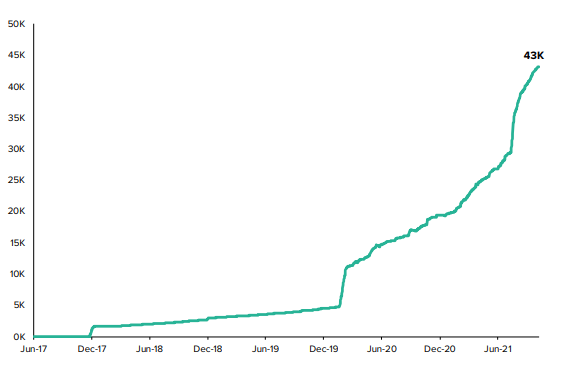
Metaverse virtual worlds have nearly 50,000 all-time users, today, which is 10 times since the beginning of 2020.
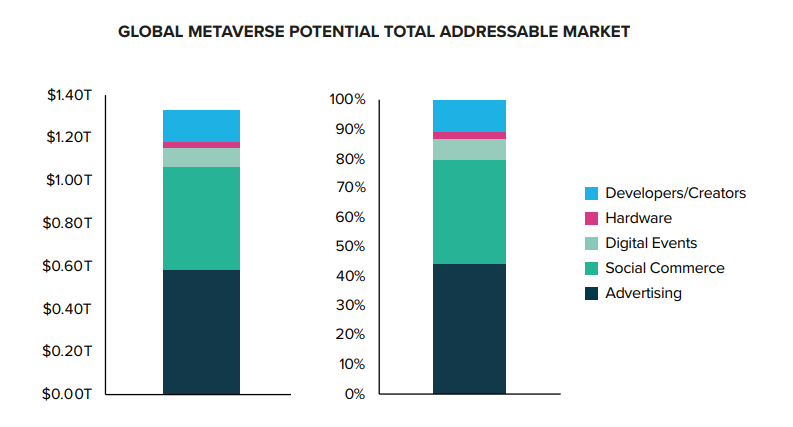
Online Gaming is just the most promptly addressable segment where value is already shifting to Web 3.0, but the Metaverse opportunity goes far beyond gaming. The Grayscale report estimates Metaverse to be a trillion-dollar revenue opportunity across social commerce, advertising, hardware, digital events, and developer/creator monetization. Though the report does not mention timeline experts in the industry believe that in a couple of years metaverse will be a $1trillion market annually.
Over the past couple of weeks, the crypto domain has witnessed large sums of money poured into Metaverse projects. One of the leading crypto exchange KCS and blockchain gaming platforms ENJ granted $100M to build the Metaverse. The existing virtual world gaming projects MANA and SAND have seen their tokens jumping over 500% value since the start of November.
In Quater 3 of 2021, total fundraising for crypto was $8.2 billion, as per the report, $1.8 B of which went to Web 3 and NFTs. Within Web 3 and NFTs fundraising for gaming applications overshadowed all other verticals, hitting around $1 billion. A key dynamic within this growth trend is the continued shift of game developer monetization. Gamers are progressively shifting away from paying to play premium games towards free games, which developers monetize by selling users in-game items to enhance gameplay as well as social status within these virtual worlds.
"Capital investment into the sector has recently started to accelerate but compared to the $10 billion that companies like Facebook plan to invest, and the amounts that could follow from other companies and venture capitalists, the Metaverse is in its early innings."
said the report.
Tech futurist Cathy Hackl believes that Fortune 200 firms are likely to scoop up gaming and VR companies via acquisitions next year to jump-start their metaverse aspirations. Meta(formerly Facebook) quietly partnered with a handful of gaming and virtual-reality firms in the recent past to shape up its metaverse dreams. Just after the rebranding as "Meta" the social giant reportedly spent more than $500M to buy Within, which is a startup co-founded by VR pioneer Chris Milk known for its Supernatural workout app.
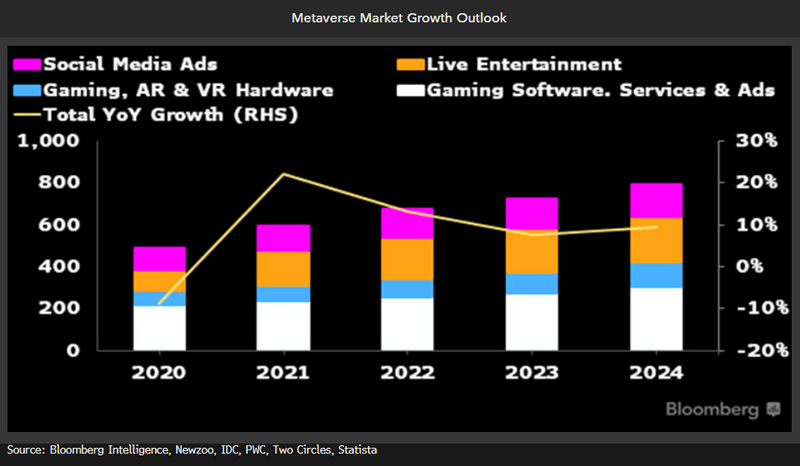
Bloomberg estimates that the global Metaverse revenue opportunity could approach $800 billion in 2024, based on its analysis and IDC, PWC, Newzoo, Statista, and Two Circles data. Live events like concerts, sports, and film showings into 3D virtual worlds represent additional opportunities for companies as they elevate online experiences into 3D social worlds to capitalize on the Metaverse opportunity.
Source: Bloomberg
Since a bigger portion of our attention is going towards digital activities, particularly following the pandemic, the physical and digital worlds are progressively merging. This is one key explanation why the metaverse has been generating significant enthusiasm, with Mark Zuckerberg's recent decision to rebrand Facebook as “Meta” the most visible embrace of this increasingly new digital reality.
Interest in the metaverse is anticipated to grow substantially as companies, investors, and tech enthusiasts want to be part of what could be the next big thing. Meta, for example, has already invested heavily in Augmented reality and Virtual reality, developing hardware like its Oculus VR headsets, while AR glasses and wristband technologies are in the works.
Get the weekly commit
New blockchain deep dives every week.
